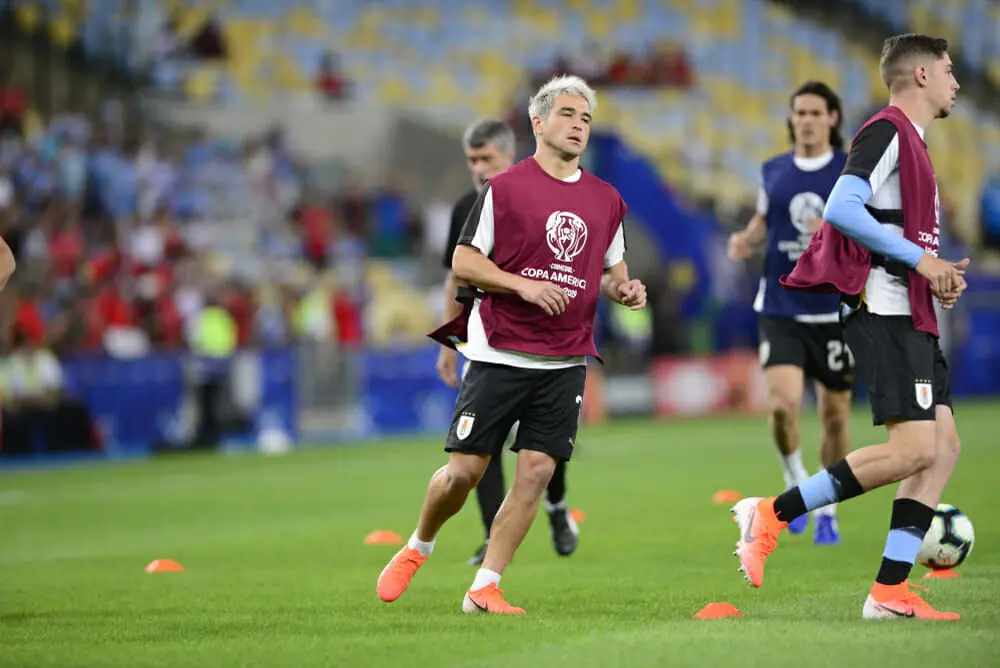
Speed in soccer is much more than how fast a player can run in a straight line. The actions that regularly influence matches are often short and explosive: accelerating to press an opponent, attacking the space behind a defensive line, recovering after possession is lost, reaching a second ball, braking before changing direction or creating separation from a defender. For coaches working at amateur, academy and semi-professional level, developing these physical qualities does not require an expensive performance department. It requires understanding what soccer speed actually looks like and then creating regular opportunities for players to practise it.
A systematic review and meta-analysis of 10 randomised controlled trials involving 260 soccer players found that structured functional training was associated with improvements in both linear sprint performance and pre-planned change-of-direction ability. The authors were careful not to claim that one training method is universally best, noting substantial differences between the programmes studied and emphasising that improvements in testing should not automatically be assumed to transfer directly into reactive agility or match performance.
An even larger recent network meta-analysis examining youth soccer provides additional practical evidence. Across 89 studies, combinations of plyometric work with sprint and/or planned change-of-direction training produced favourable estimates for explosive power, acceleration, 20-m sprint performance and change-of-direction ability when compared with normal soccer training. However, the researchers rated much of the evidence as low or very low certainty and stressed that these results should be interpreted as useful signals rather than a rigid training prescription.
For the coach, the message is therefore more useful than simply declaring one exercise “best”. Players improve speed through repeated exposure to the qualities that speed requires: force production, coordination, acceleration, sprinting, braking, changing direction and eventually reacting to the information provided by the game. The challenge is to build those qualities into the training week without turning soccer practice into an athletics session.
This is where the ISSPF Certificate in Strength & Conditioning for Soccer Performance becomes particularly relevant. Designed for coaches from beginner through elite level, the course focuses on practical methods for improving speed, endurance and strength while connecting physical preparation directly to match performance.
Building Acceleration for the Actions That Decide Soccer Moments
Acceleration is one of the most useful speed qualities for the everyday soccer coach to develop because so many actions begin from low or moderate speed rather than from a flying sprint. A player closes down the centre-back from five metres away, reacts to a loose pass, drives beyond a midfielder, moves to cover a teammate or accelerates into the penalty area. In each example, the ability to generate speed quickly is more relevant than how fast that player might eventually run over 40 or 50 metres.
Early acceleration requires players to generate force into the ground and direct enough of that force horizontally to move their body forward. Coaches do not need a biomechanics laboratory to influence this. Simple coaching cues can help: encourage players to push the ground away strongly during the first steps, maintain an appropriate forward body angle, use the arms aggressively and avoid standing upright too early. The objective is not to make every player look identical but to improve the quality of their first few steps.
The new functional-training review supports the idea that integrated strength and movement work can contribute to better sprint performance. Across seven trials involving 164 players, functional-training groups produced favourable improvements in linear sprint tests, although the magnitude varied considerably between studies. The authors highlighted that sprinting is influenced by neuromuscular capacity, mechanics and the ability to apply force effectively, which means coaches should not expect one drill to develop speed in isolation.
Strength training can therefore support acceleration even when a coach has only limited gym access. Squats, split squats, lunges, step-ups and appropriate single-leg exercises can help players develop the force-producing capacity required to accelerate. For younger players or teams without gym facilities, bodyweight variations, partner resistance and carefully coached jumping exercises can provide a useful starting point.
Research involving highly trained youth soccer players reinforces this principle. A systematic review and meta-analysis of 34 studies involving 1,396 players found that strength, plyometric and combined training all produced improvements across measures of strength, power, acceleration, speed and change-of-direction performance. Acceleration showed particularly consistent positive responses, supporting the value of physical training alongside normal soccer practice rather than assuming playing the game alone will maximise these qualities.
However, the coach should still allow players to accelerate at high intent. Strength work provides capacity, but players also need to practise expressing that capacity through actual running. A simple five- or ten-metre race can therefore be extremely valuable. Two players begin from different positions—standing, side-on, facing backwards or after a short technical action—and accelerate towards a target. The distance can remain short enough that quality stays high and players can recover properly before repeating the action.
This is also where coaches need to distinguish speed training from conditioning. If players complete ten maximal accelerations with very little rest, the session quickly becomes a repeated-effort conditioning exercise. That may be useful on another day, but it is no longer primarily developing maximal acceleration quality. When the objective is speed, players generally need enough recovery to produce genuinely fast efforts.
For amateur coaches, this can be incorporated without sacrificing valuable ball time. A warm-up might progress from movement preparation into two or three low-volume jumping exercises before players complete four to six short accelerations. The entire block can take around ten minutes and creates a very different physical stimulus from jogging laps around the pitch.
ISSPF faculty member Efthymios Kyprianou provides an especially useful bridge between sport science and coaching practice. His work has included academy and first-team physical preparation in Europe, MLS and Aspire Academy, with a strong focus on game-related physical training and player-development systems. His ISSPF teaching includes peak-velocity exposure and integrated physical training, reinforcing the principle that speed work should ultimately prepare players for the movements demanded by soccer rather than exist as a separate fitness exercise.
Training Sprinting, Deceleration and Change of Direction Together
Acceleration is only one part of soccer speed. Players also need opportunities to reach higher velocities, control those speeds and redirect their movement. A defender might sprint back towards goal before braking to deal with an attacker cutting inside. A winger may accelerate down the outside before decelerating, changing direction and attacking centrally. A pressing midfielder may sprint towards the ball, stop suddenly and immediately re-accelerate when the opponent changes the direction of play.
This is why coaching only “quick feet” can be misleading. Agility ladders and coordination exercises can have value within warm-ups, particularly for rhythm, coordination or general movement preparation, but they do not expose players to the same forces, speeds or braking demands generated during genuine soccer actions. Moving the feet quickly through a ladder is not the same physical task as sprinting towards an opponent, stopping under control and re-accelerating in response to the next movement.
Deceleration deserves much more attention in amateur training. The faster a player moves, the greater the challenge involved in reducing that speed. Players need adequate strength and movement control to absorb force before they can efficiently redirect it. Coaches can begin simply by asking players to accelerate for five to ten metres and then stop within a defined zone. As competence improves, the stopping distance can be reduced or a directional change can be added.
The new recent meta-analysis found favourable changes in planned change-of-direction performance following functional training, but its authors also made an important distinction: the research largely involved pre-planned tests. Knowing in advance that you are cutting left around a cone is very different from reading an opponent and deciding where to move during a game.
For the coach, this provides a useful progression. Players can initially learn the physical skill through planned movements, where attention can be given to body control, braking and re-acceleration. Once the movement becomes more competent, uncertainty can be introduced. A partner points left or right, the coach provides a visual signal, or the player responds to the movement of an opponent. Eventually, the same qualities can be trained inside 1v1 and small-sided games where perception and decision-making determine the movement.
That progression prevents a common coaching mistake: jumping directly from cone drills into completely chaotic game situations. Planned change of direction helps players build the physical skill, while reactive agility teaches them when and how to apply it. Both have a place.
Plyometric training can contribute to this development because jumping, hopping and bounding expose players to rapid force production and absorption. The current time youth network meta-analysis found encouraging results when plyometric work was combined with sprint and change-of-direction training, although the authors again warned that the quality of evidence does not justify claiming that one combination is universally superior.
For coaches without specialist equipment, the practical options are simple. Low-level pogo jumps, forward bounds, lateral hops and small hurdle jumps can all be introduced progressively. Quality should remain the priority, particularly with developing players. The purpose is not to create exhaustion but to encourage fast, controlled contacts with the ground.
Sprinting itself must also remain part of the programme. Research examining high-speed running in professional soccer has recommended using a combination of running drills, field-based exercises and medium- or large-sided games to expose players to higher speeds. The key point is that small-sided games alone may not always provide enough space for players to reach high velocities, especially when the pitch is very compact.
This is a particularly useful lesson for amateur coaches who rely heavily on 4v4 and 5v5 games. Those formats can be outstanding for technical actions, pressing, duels and short accelerations, but players may rarely get enough open space to sprint. Coaches can solve this with a small amount of deliberate speed work before the game or by occasionally using larger areas that encourage forward runs and defensive recovery.
The existing ISSPF article Developing Soccer Specific Speed explores this question in greater depth, including peak-velocity exposure, change of direction and repeated sprint demands. ISSPF’s wider Strength & Conditioning pathway also develops these principles from Foundation through Advanced and Diploma level, giving coaches a structured progression rather than a collection of disconnected fitness drills.
A Practical 15-Minute Soccer Speed Block for Everyday Coaches
The greatest barrier for most amateur coaches is not understanding that speed matters. It is finding enough training time to develop it. A team training twice per week may have only three hours in total to prepare technically, tactically and physically. The solution is not to create a separate 45-minute conditioning session every time. Instead, speed development can be embedded into a short, repeatable block within the normal soccer session.
A useful 15-minute structure can begin with three to four minutes of movement preparation. Players perform dynamic movements such as lunges, skips, low-level hops and controlled changes of direction. The purpose is to increase readiness rather than tire the group.
The next three to four minutes can focus on explosive preparation. Coaches might use two sets of three low-volume jumps, bounds or lateral hops before progressing into acceleration. Players can then complete four to six short sprints over five to fifteen metres with generous recovery between repetitions. The coach should encourage genuine speed rather than treating the work as another fitness circuit.
The final part of the block can connect the physical quality to soccer. Two players might race towards a ball released by the coach, compete in a 1v1 after a short acceleration or react to a visual cue before trying to finish into a mini-goal. This allows physical speed to transition into perception, decision-making and technical execution.
The same framework can be modified according to the objective. On an acceleration-focused day, the distances remain short. When the objective is exposing players to higher speed, the coach can use longer 20–30-metre efforts with fewer repetitions. On a change-of-direction day, players might accelerate, brake and cut before the final action. The key is identifying one primary physical objective rather than attempting to train everything simultaneously.
A normal amateur training session might therefore begin with the 15-minute speed block, move into a technical-tactical practice, progress into a conditioned game and finish with a larger-sided game. The physical work has not replaced soccer; it has prepared players to perform soccer actions more explosively.
This is also where the game model should influence conditioning. A team wanting to press aggressively needs players capable of repeated short accelerations and rapid changes of direction. A team that attacks quickly into space may place greater emphasis on longer forward sprints. A deeper defensive team may still require significant acceleration and sprint capacity because defenders need to recover quickly when the block is broken. ISSPF’s article on Preseason Soccer Coaching and Game Model Development reinforces this principle: physical preparation should support how the team intends to play rather than operate independently from the tactical model.
Coaches should also consider age and training history. Younger or less experienced players do not need the same training volume as adult professionals. They benefit from learning sound movement skills, becoming stronger progressively and experiencing frequent high-quality sprint opportunities without excessive fatigue. The latest youth research indicates that combined approaches involving strength, plyometrics, sprinting and change-of-direction work can produce useful adaptations, but it does not justify simply copying professional training volumes into youth soccer.
For adult amateur players, the challenge is often availability. Some players arrive directly from work, miss sessions or have very different fitness backgrounds. The coach therefore needs to progress the group sensibly. A player who has missed three weeks should not immediately complete the same high-speed volume as somebody who has trained consistently. Basic observation and communication can provide useful information even when GPS is unavailable.
Coaches also need to protect quality. When sprint mechanics visibly deteriorate, players slow considerably or the session becomes dominated by fatigue, the speed-development objective is probably being lost. More repetitions are not always better. Four genuinely fast efforts can provide a more appropriate stimulus than twelve tired runs completed because the coach wants everyone to “work hard”.
This is perhaps the most important shift for the mass coaching market. Traditional soccer fitness has often rewarded visible fatigue. Players run laps, complete shuttle runs and finish sessions exhausted because exhaustion appears to prove that conditioning has occurred. Speed training requires a different mindset. The objective is often to produce high-quality explosive actions while players are fresh enough to move quickly.
That does not mean endurance and repeated-effort conditioning are unimportant. Soccer requires players to repeat high-intensity actions throughout the match. However, maximal speed, acceleration and movement quality should first be developed before coaches expect players to reproduce those qualities repeatedly under fatigue.
The ISSPF Certificate in Strength & Conditioning for Soccer Performance is particularly well positioned for coaches wanting to develop this understanding. The course has been designed for beginner through elite-level practitioners and connects modern strength, speed and conditioning methods with the physical requirements of soccer. For coaches currently relying mainly on traditional fitness drills, it provides a pathway towards more purposeful physical preparation.
Developing explosive players does not require turning every coach into a sports scientist. It requires understanding that speed is trainable, acceleration should be practised, players need opportunities to sprint, deceleration must be coached rather than assumed, and change of direction eventually needs to progress from predictable drills into genuine soccer decisions. A short, well-designed speed block delivered consistently can therefore add significant value to the normal training week.
For the everyday coach, the practical starting point is simple: identify the match actions you want your players to perform faster, create enough space for them to produce genuine speed, provide sufficient recovery for quality, and progressively connect the physical action back to the ball, the opponent and the tactical problem. That is how strength and conditioning becomes soccer coaching rather than fitness added around the edges of the game.
Develop your understanding of soccer-specific speed, strength and conditioning through the ISSPF Certificate in Strength & Conditioning for Soccer Performance, and learn how to turn physical preparation into practical improvements on the pitch.
References (3)
Beato, M., Drust, B. and Dello Iacono, A. (2021) ‘Implementing high-speed running and sprinting training in professional soccer’, International Journal of Sports Medicine, 42(4), pp. 295–299.
Yang, H., Lan, Y., Chen, Y. and Zeng, S. (2026) ‘Effects of functional training on linear sprint and change-of-direction performance in soccer players: A systematic review and meta-analysis’, Frontiers in Physiology, 17, 1951674.
Wang, K., He, J., Zhu, A. and Bi, X. (2026) ‘Effects of different training modalities on lower-limb explosive power, acceleration, 20-m sprint performance, and change-of-direction ability in youth soccer players: A systematic review and network meta-analysis’, BMC Sports Science, Medicine and Rehabilitation, 18, 410.
The course covered in this article
Did you enjoy this article?
Thanks for your feedback!